Columbia Icefield Adventure: Riding the Ice Explorer onto the Athabasca Glacier
The Columbia Icefield Adventure is the ride people picture when they imagine standing on a glacier: a machine the size of a small house crawls down onto the Athabasca Glacier and lets you out to walk on ice that fell as snow before the pyramids were built. It is the flagship experience at the icefield, and it is easy to do badly if you misjudge the time, the cold or the ticket. Here is how it really works.
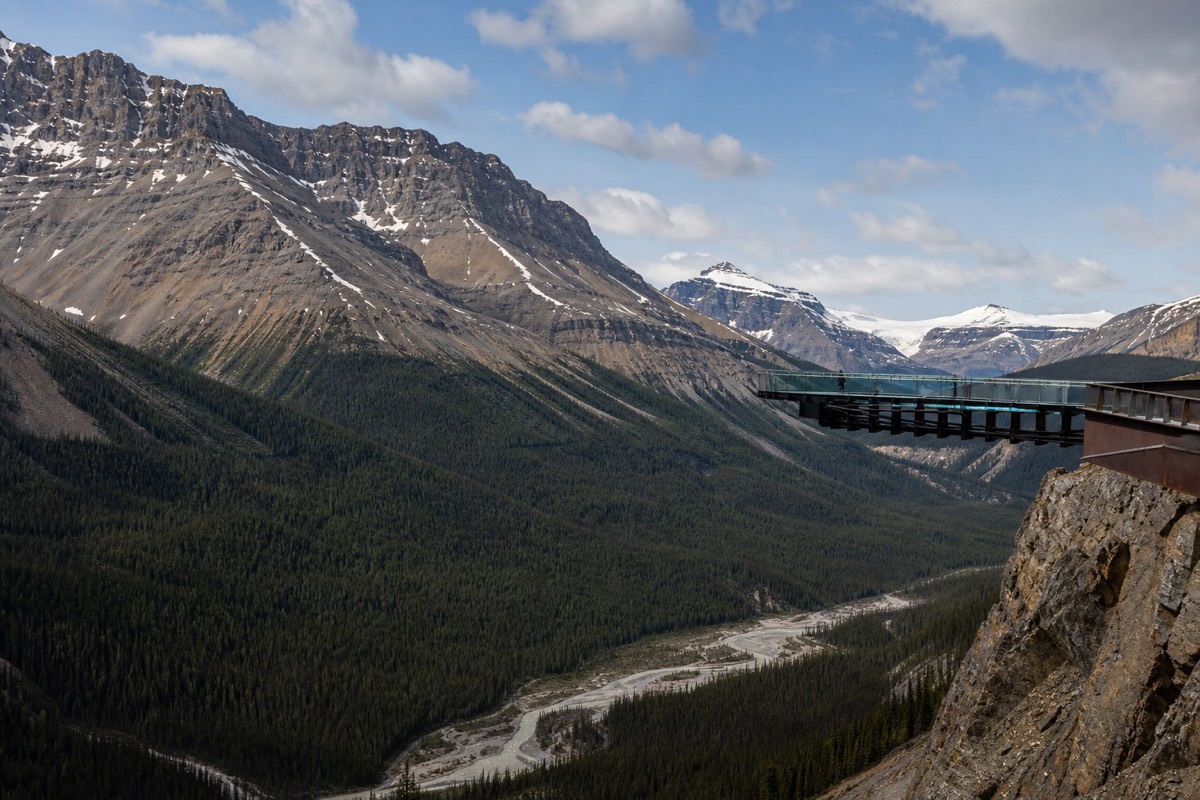
Pair the glacier ride with the glass-floored Skywalk in one attraction booking. Explore Ice Explorer + Skywalk
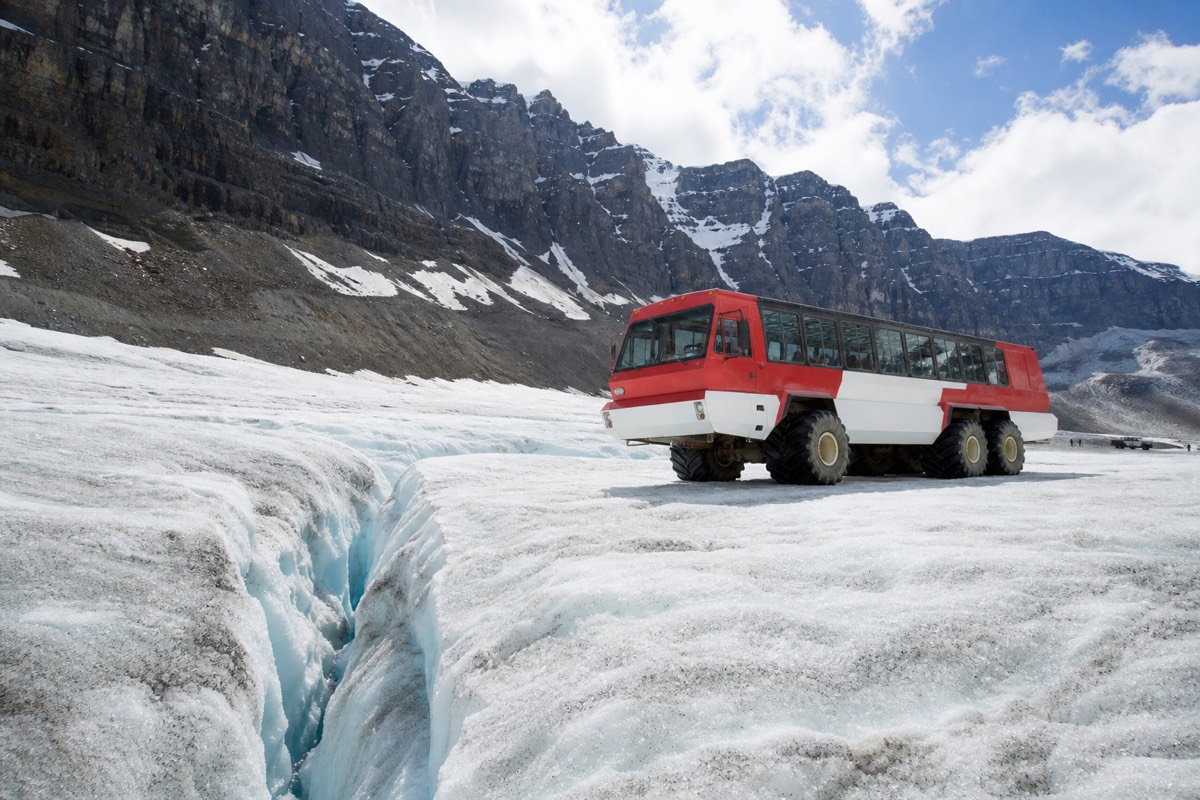
A red-and-white machine the size of a small house tips over the lip of a moraine, its tyres taller than the people photographing it, and rolls down onto a river of ice. That first sight of an Ice Explorer committing to the glacier is why the Columbia Icefield Adventure sells out through summer. The ride is short, the setting is enormous, and the whole thing is easier and colder than most people expect. This guide walks through the vehicle, the ride, the ice time, the price and the honest verdict.
The Ice Explorer ride, end to end
The shape of the Columbia Icefield Adventure from the Discovery Centre and back, with the time you actually spend on the ice and the current combined ticket price. Compiled from the operator's published information and the tours we list; figures move, so treat them as a recent snapshot.
What is the Columbia Icefield Adventure?
The Columbia Icefield Adventure is a guided ride in a giant all-terrain Ice Explorer that carries you from the Glacier Discovery Centre down onto the surface of the Athabasca Glacier, where you step out and walk on the ice. It is almost always sold with the Glacier Skywalk as a combined ticket, and it is the signature experience at the icefield.
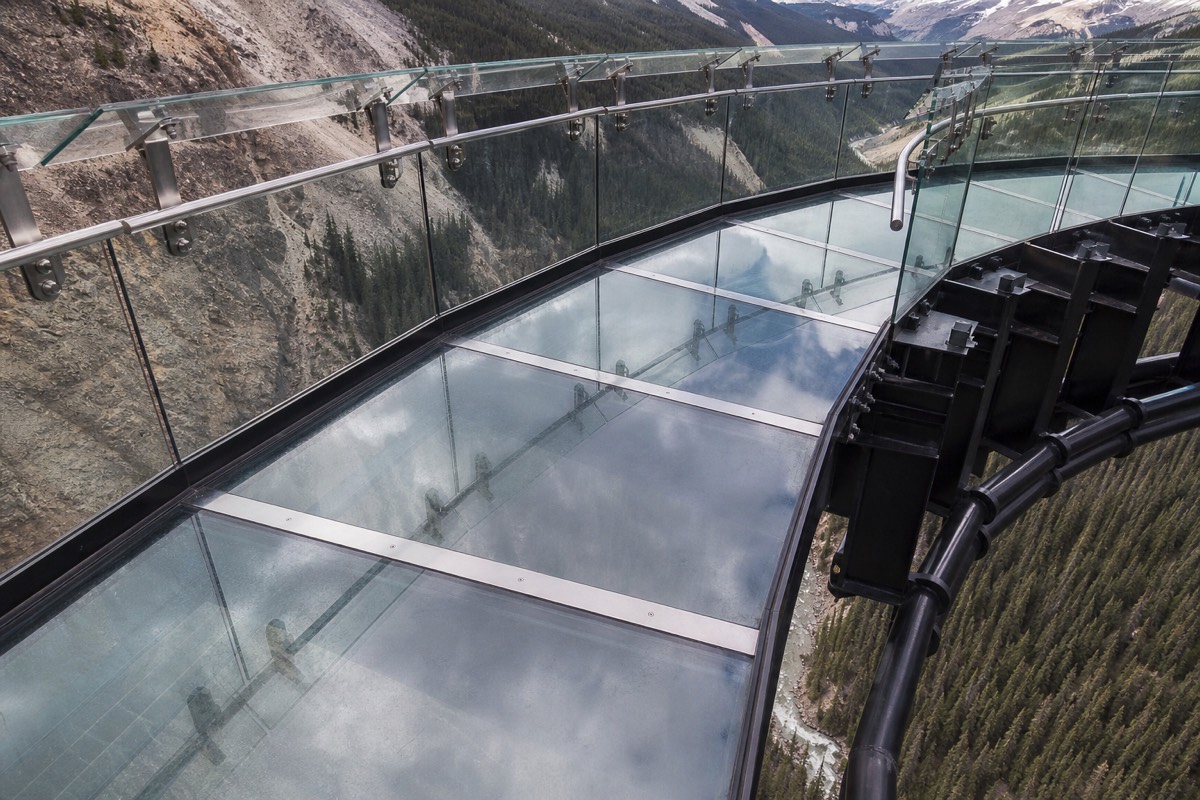
Nobody is allowed to simply drive a car onto the glacier or wander onto it alone, for good reason: the ice hides crevasses and moulins that can be lethal. The Adventure exists because it is the one safe, engineered way for an ordinary visitor to stand in the middle of a working glacier rather than at its toe. It runs from the same building as everything else up here, which we cover in the guide to the Glacier Discovery Centre, and it pairs naturally with the glass-floored Skywalk a few minutes down the road.
What exactly is an Ice Explorer?
An Ice Explorer is a purpose-built, six-wheeled all-terrain vehicle designed to travel on ice, seating around 56 passengers on tyres taller than an adult. Only a couple of dozen of these machines exist anywhere in the world, and nearly all of them work this single glacier, which is part of what makes the ride feel so unlike a normal bus.
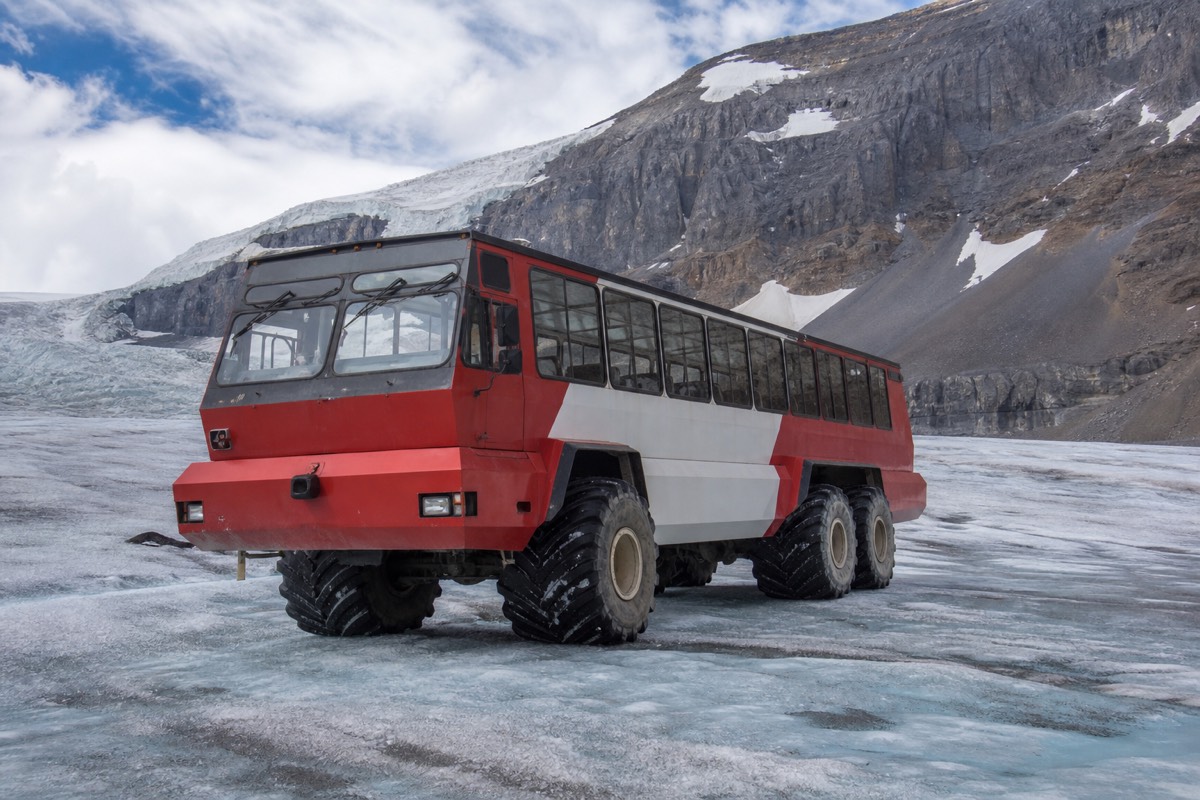
They are not converted coaches. Each one is engineered for grip and slow, controlled descent, because the access road down the lateral moraine is punishingly steep, one of the steepest vehicle grades anywhere that ordinary visitors ride. The scale is the first surprise and the traction is the second: the driver eases the whole rig down an incline that looks impossible, then trundles out across the ice as if it were a car park. The operator, whose fleet and vehicle detail are published by the official Banff Jasper Collection, keeps the machines and the routes on the ice tightly controlled for safety.
| Ice Explorer | Detail |
|---|---|
| Type | Purpose-built all-terrain glacier vehicle |
| Capacity | Around 56 passengers |
| Tyres | Taller than an adult, built for ice grip |
| Global fleet | Only around two dozen exist, nearly all here |
| The steep bit | A notoriously steep moraine access grade |
| Where it goes | Onto the flat mid-section of the Athabasca Glacier |
What happens on the ride, minute by minute?
From the Discovery Centre you board a shuttle across the road, transfer to an Ice Explorer at the ice edge, ride down the steep moraine and out onto the glacier, then step off into a roped-off area to walk the ice for around twenty minutes before the return. The whole loop takes about eighty minutes.
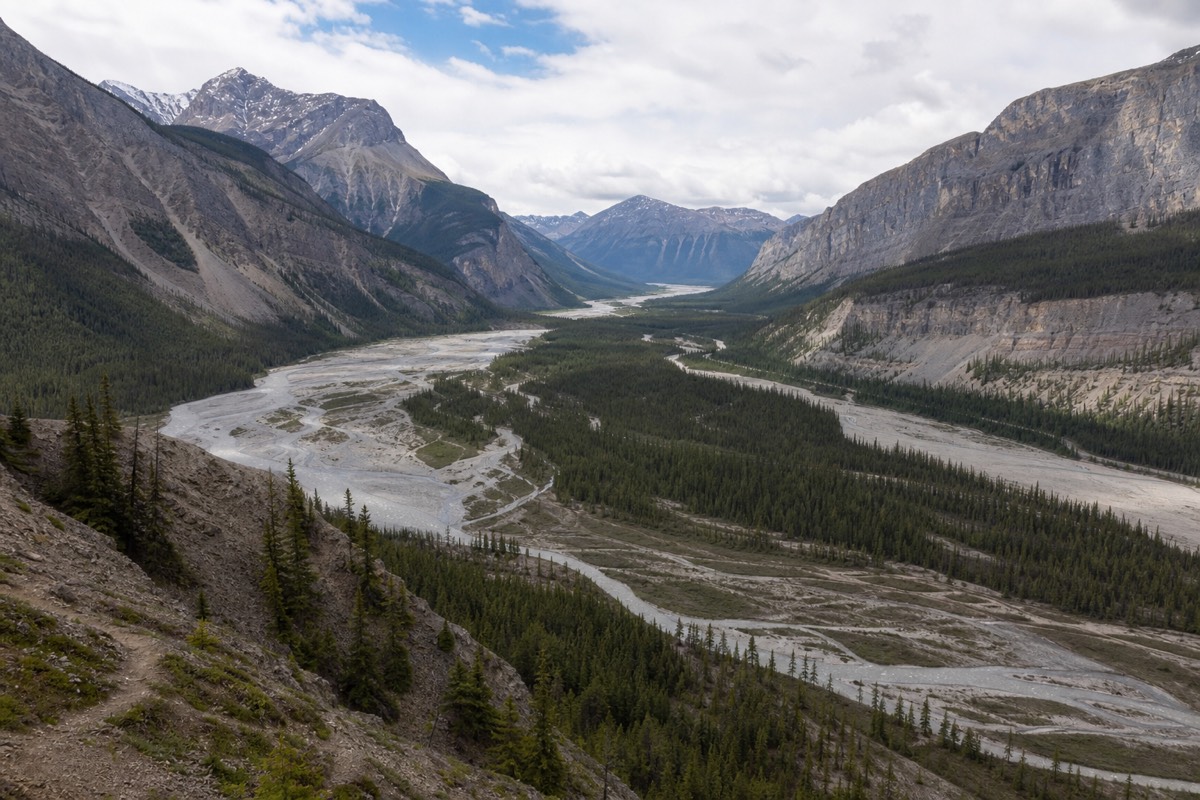
The choreography is smooth because thousands of people do it every day in season. The transfer point is where you swap the ordinary shuttle for the giant vehicle, and the descent is the theatrical moment, slow, steep and loud. Out on the ice the driver-guide parks, opens the doors, and points you to a marked zone where it is safe to stand. You get time to touch the ice, take photos, feel the cold rising through your boots, and, if conditions allow, look at a meltwater rivulet. Then everyone reboards and the machine climbs back up.
| Stage | Roughly | What happens |
|---|---|---|
| Shuttle from the Discovery Centre | 5 min | Short hop across the highway to the ice edge |
| Transfer to the Ice Explorer | 10 min | Board the giant vehicle |
| Descent and drive onto the ice | 15 min | The steep moraine grade, then out onto the glacier |
| On the ice | ~20 min | Walk the marked zone, photos, meltwater |
| Return | 25 to 30 min | Back up the moraine and to the Centre |
How much time do you actually get on the glacier?
You get roughly twenty minutes standing on the ice. It is shorter than most people picture, and it is spent inside a roped safety zone rather than roaming free, so the value is in the setting and the strangeness of it, not in a long hike across the glacier.
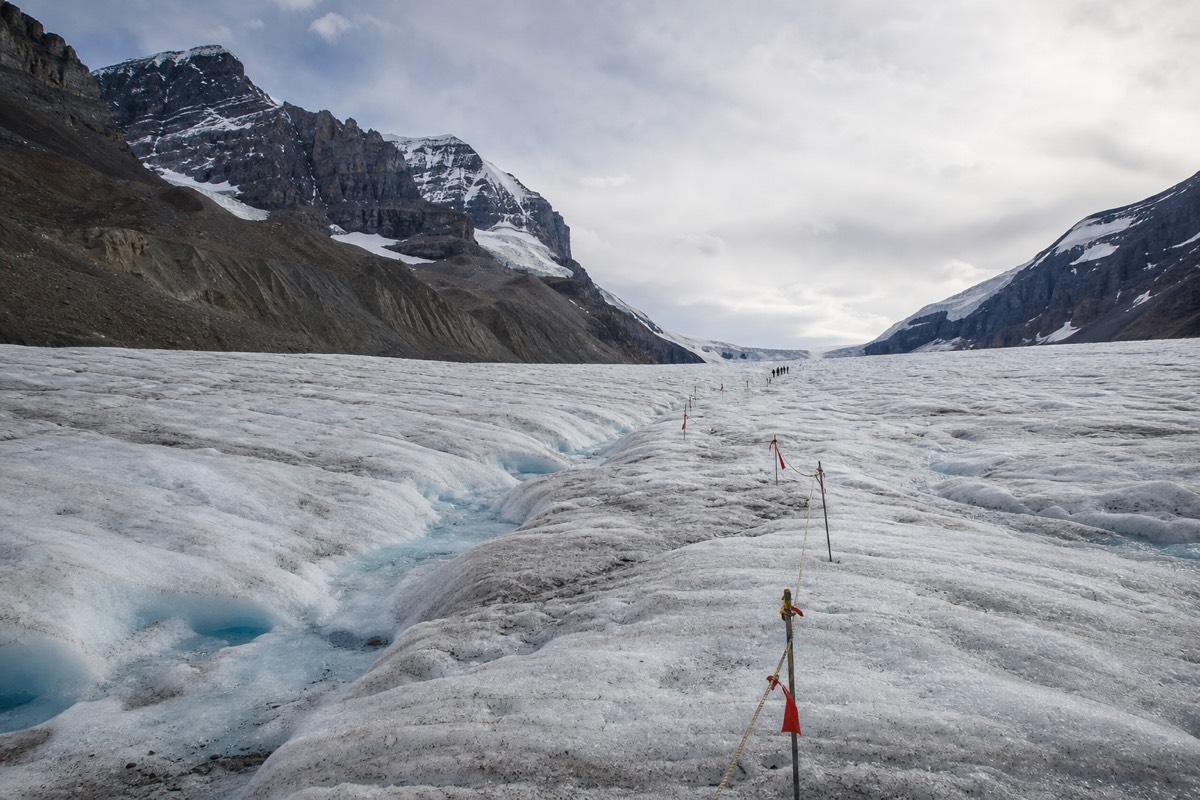
Twenty minutes is enough to feel the scale, take the photographs that matter, and understand viscerally that you are standing on hundreds of metres of moving ice. It is not enough to explore. Visitors who want to actually walk out across the glacier on foot, roped to a mountain guide, want a different product entirely, which we compare below and cover fully in the guide to walking on the Athabasca Glacier. If drinking straight from the source is on your list, see our notes on drinking the glacier meltwater first.
How much does the Columbia Icefield Adventure cost in 2026?
For 2026, the Adventure is normally sold combined with the Skywalk for around C$126 for adults, cheaper if you book well ahead or take a late-afternoon departure, and less again for children. Buying the glacier ride without the Skywalk saves little, which is why the combined ticket is what almost everyone chooses.
The pattern to remember is that the earlier you commit and the later in the day you go, the less you pay. Mid-day walk-up in peak season is the most expensive way to do it. If you are travelling on one of our guided day tours, check whether the glacier tickets are already included in your fare before you pay again at the counter, because some tours bundle them and some do not. The full ticket and price breakdown compares every route to the ice.
| Option in 2026 | Adult (approx.) | Notes |
|---|---|---|
| Adventure + Skywalk combo | ~C$126 | The standard, best-value ticket |
| Booked well ahead / late slot | Often ~15 to 20% less | Prices rise closer to the date |
| Included on some day tours | Bundled | A few full-day tours fold it into the fare |
| Child rate | Roughly half | Under-sixes usually free |
These are current starting figures and shift with season and demand, so confirm the live price when you book.
Ice Explorer vs a guided glacier walk: what is the difference?
The Ice Explorer drives you onto the glacier for a short visit within a designated area, subject to the operator’s suitability requirements; a guided glacier walk puts you on foot, led by a glacier guide, with duration and traction equipment depending on the operator. The Adventure is the accessible headline; the walk is the deeper, more demanding version for people who want to earn it.
They suit different travellers. Families, older visitors, anyone short on time or mobility, and first-timers who just want to say they stood on a glacier are served perfectly by the Ice Explorer. Fit visitors who want the ice under their own boots, away from the vehicle, choose the guided walk. Both are legitimate; neither replaces the other. Our piece on whether you can walk on the ice yourself lays out the rules and the options.
| Ice Explorer Adventure | Guided glacier walk | |
|---|---|---|
| How you travel | Ride down in the vehicle | On foot with crampons |
| Time on ice | ~20 minutes, roped zone | 2 to 5 hours, out on the glacier |
| Fitness needed | Almost none | Moderate to good |
| Guide | Driver-guide on the vehicle | Certified mountain guide, small group |
| Best for | Families, first-timers, tight schedules | Active visitors who want real ice time |
When does the Ice Explorer run, and when should you go?
The Ice Explorer operates a seasonal calendar, roughly mid-April to mid-October, closing through winter when the glacier is buried in snow and unsafe. Inside the season, early and late departures are calmer and cheaper than the mid-day peak, when coaches from Banff, Lake Louise and Calgary all arrive together.
May through September is the dependable window, with July and August the warmest and busiest. Booking the first or last runs of the day both saves money and thins the crowd on the ice. The ice itself is always near freezing regardless of the calendar, so a hot July valley still means a cold glacier. Weather up here changes by the hour, which we cover in the guide to the best time to visit.
| Period | Ice Explorer status | Feel |
|---|---|---|
| Mid-April to May | Opening season | Quiet, cold, deep snow around |
| June | Open | Long days, building crowds |
| July to August | Peak | Warmest, busiest, book ahead |
| September | Open | Cooler, thinner crowds, gold larches |
| October | Closing weeks | Cold, then winter shutdown |
Is the Ice Explorer safe, and can anyone do it?
Yes, and yes for almost everyone. The ride is designed for the general public, from young children to older travellers, with driver-guides trained for the ice and a roped, marked walking zone rather than open glacier. The main limits are cold tolerance and the short walk on a slick surface, not fitness, age or nerve.
The Discovery Centre and the boarding process are built for a steady flow of visitors, with stroller-friendly paths and staff used to handling large, mixed groups. Children treat the giant vehicle as the highlight before they even reach the ice, and the "glacier water challenge", filling a bottle from a meltwater trickle, is a reliable hit with families. The genuine cautions are simple: the surface underfoot is slippery, so grippy shoes and a careful pace matter, and anyone who truly cannot cope with near-freezing wind will be uncomfortable for the twenty minutes on the ice. The glacier sits inside a national park, and Parks Canada restricts travel on the ice to guided operations precisely because of the hidden crevasse risk, which is why the roped zone is not optional. If you have specific mobility needs, check the current transfer arrangement when you book, since you change from a shuttle onto the Ice Explorer at the ice edge.
Why is the descent onto the glacier so steep?
The Ice Explorer reaches the glacier down a lateral moraine, the ridge of rubble the ice bulldozed up over centuries, and that ramp is one of the steepest grades any passenger vehicle regularly drives. The vehicles exist precisely because an ordinary bus could not hold traction on it.
It is the part of the ride people talk about afterwards. The machine tips over the lip, the nose drops, and for a few seconds the view through the windscreen is mostly ice and sky while the driver eases it down under careful control. There is no real danger in it, the vehicles and drivers do this hundreds of times a day in season, but the sensation is theatrical, and it is a large part of why the short ride feels like an event rather than a shuttle. Once down, the same traction lets the vehicle trundle out across the flat mid-section of the glacier to the parking spot where you step onto the ice.
Is the Columbia Icefield Adventure worth it?
For most visitors, yes. Standing in the middle of a living glacier is a genuine rarity, the ride is safe and easy, and the combined ticket makes it good value. It is a weaker buy only if you truly cannot tolerate cold, are on a tight budget with a long list, or specifically want to hike the ice rather than ride it.
The honest caveat is expectation. Twenty minutes in a roped zone is not a glacier expedition, and people who arrive picturing a solo wander come away slightly deflated. Arrive knowing it is a short, awe-first experience and it lands. Anyone wanting more should either add the guided walk or pair the ride with the rest of the Parkway. For the wider case, see whether the tour is worth it.
How do you get to the Ice Explorer departure point?
The Adventure departs from the Glacier Discovery Centre on the Icefields Parkway. From Jasper it is about 103 km, roughly an hour and a quarter. From Lake Louise it is around 130 km, and from Banff about 185 km, or two and a half to three hours, with Calgary another two hours beyond that.
Self-drivers should fuel up before leaving town, since the only pump on the route is at Saskatchewan River Crossing and there is effectively no cell service the whole way. The alternative is to let a guided day tour handle the road and the timing, which also means arriving on the same schedule as your booked ice slot. Our full-day Icefield adventure is built around exactly this, and the road itself is one of the reasons to come, covered in the guide to the drive up the Icefields Parkway. If you are picking a base, our notes on the run up from Banff compare the southern approach against a shorter start from Jasper.
| Start | Distance to the Discovery Centre | Driving time |
|---|---|---|
| Jasper | ~103 km (64 mi) | ~1 hr 15 min |
| Lake Louise | ~130 km (80 mi) | ~1 hr 45 min |
| Banff | ~185 km (115 mi) | ~2.5 to 3 hr |
| Calgary | ~300 km (185 mi) | ~4.5 hr |
What should you wear and bring on the Ice Explorer?
Dress as if it is winter, because on the ice it is. Even a hot valley day means near-freezing air and wind on the glacier, so layers, a windproof jacket, a hat, closed-toe shoes with grip and sunglasses are the difference between a good visit and a miserable one. Bring a bottle for meltwater and sunscreen for the glare.
The most common regret up here is trusting the town weather. It is routinely fifteen to twenty degrees colder on the ice than in Banff or Jasper, and the reflected sun burns faster than people expect. Grippy footwear matters because the ice is slick, and a small daypack keeps your camera and water to hand. Our full packing checklist is in the guide to what to wear on the ice.
What are the common mistakes on the Ice Explorer?
The recurring mistakes are underdressing, arriving mid-day into the coach crush, expecting far more ice time than the twenty minutes on offer, and paying twice for tickets already included in a tour fare. Each is simple to avoid with a little planning.
People also skip the meltwater moment because they did not bring a bottle, and later wish they had. And a fair number rush the day so hard that the glacier becomes a box to tick rather than a place to feel. Give the Discovery Centre a real half-day, take an early or late slot, and let the scale of the place actually land.
So, is the ride onto the glacier for you?
If you want to stand in the heart of a glacier without technical gear or real risk, the Ice Explorer is one of the best-value pieces of awe in the Rockies: book ahead, take an early or late departure, dress for winter, and pair it with the Skywalk on the combined ticket. If you crave a longer, harder day on the ice, add a guided walk instead. Either way, the simplest path is to let a guided trip carry the driving and the timing, and Columbia Icefield Tours lines up the operators who run the Parkway to the Discovery Centre and back, so the ice is the only thing you have to concentrate on.